
Implementing "Philosophy" into Decision-Making in the AI Era External Chief Philosophy Officer (CPhO) for Japanese Companies
Propose a new mechanism to support the determination of ethics, value, and meaning from outside of management.
BB Driving Force Co., Ltd.

BB Driving Force Co., Ltd. (Head Office: Tokyo, CEO: Hideki Fujimoto) has launched an external Chief Philosophy Officer (CPhO) service to address management decisions that are becoming increasingly complex with the spread of generative AI. This service aims to incorporate fundamental questions of not only "what can be done" but also "what can be done" and "which value should be prioritized" into the management decision-making process in AI utilization, business transformation, human resource system, governance, etc.
Information page: https://bb-drivingforce.com/external-cpho
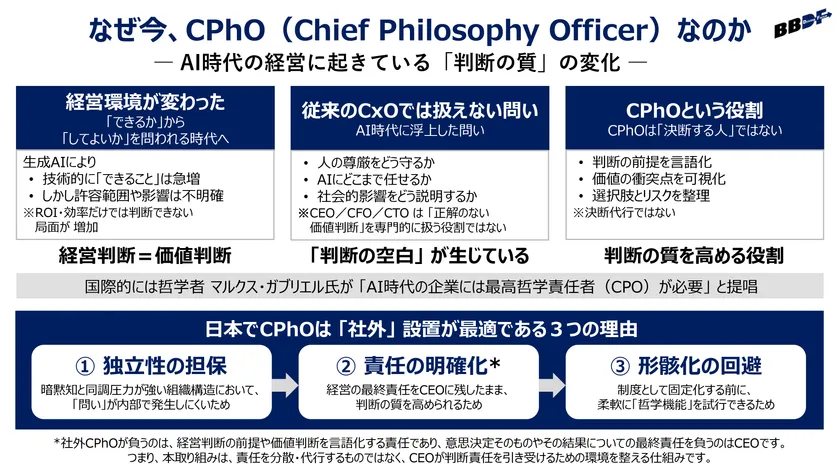
External CPhO in the AI Era
In recent years, while generative AI has dramatically increased operational efficiency and productivity, it has also presented companies with questions that cannot be answered solely by conventional numerical indicators and efficiency, such as "how to protect human dignity" and "to what extent can we entrust AI to make decisions? In response to this situation, philosopher Markus Gabriel has proposed that companies in the AI age should have a Chief Philosophy Officer as a member of the management team and integrate ethics, value, and meaning judgment into management.
This concept is one of the ideal management models in the AI era. On the other hand, given the organizational culture and decision-making structure of Japanese companies, it is not necessarily optimal to suddenly fix the philosophy function within the company. Japanese society is deeply rooted in a culture that values tacit knowledge and peer pressure, and value judgments and ethical issues are treated as "air," making it difficult to raise them as explicit "questions.
Against this backdrop, we have adopted an "external CPhO" as the optimal solution for Japanese companies at this point in time. The CPhO, a third party from outside the company, will verbalize the assumptions underlying management decisions and issues that are often overlooked, and create an environment in which the CEO can take ultimate responsibility for making decisions, thereby simultaneously enhancing the quality of decision-making and accountability.
■Key Roles of External CPhOs
Assist in designing decision criteria (philosophy/policy) for AI and data utilization
Decision-making review in management meetings, new business, human resource system, and AI governance
Assist in the design of decision criteria (philosophy/policy) for AI utilization and data application, and review of decision-making in management meetings, new business, HR systems, and AI governance
Support for the gradual internalization of the philosophy function with a view to establishing an internal CPO in the future.
Note that the "responsibility" of the external CPhO is to take on the language of the assumptions underlying management decisions, and the ultimate responsibility for decision-making is clearly attributed to the CEO. In other words, the CPhO assumes questions in order for the CEO to assume responsibility.
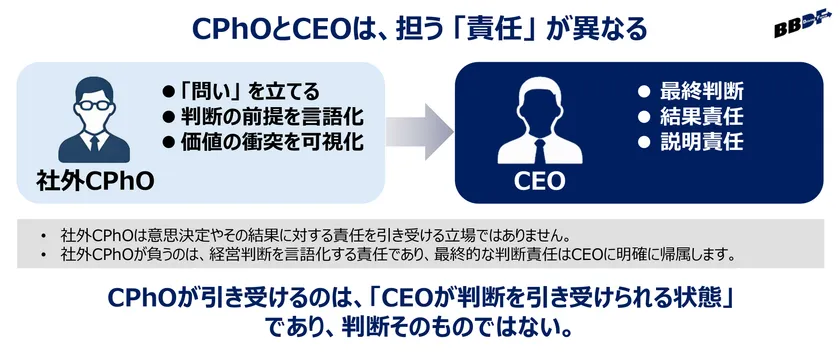
Roles and Responsibilities of CPhO
■Three reasons why an "external CPhO" is optimal in Japan
(1) Because "questions" are difficult to generate internally in an organizational structure with strong tacit knowledge and peer pressure
In Japanese companies, value judgments and decision-making assumptions tend to be shared as tacit knowledge, making it difficult to visualize objections and ethical dilemmas. The external CPhO, from the standpoint of not being assimilated into the organization, presents the unspoken assumptions as questions.
(2) Because the quality of decisions can be improved while leaving the ultimate responsibility for management to the CEO.
Philosophy and ethics do not substitute for decision-making. The external CPhO organizes the axis and issues of judgment, and the CEO is responsible for the final decision, thereby enhancing the accuracy of decision-making while maintaining a clear sense of responsibility.
(3) Because the "philosophy function" can be flexibly tried out before it is fixed as a system
Philosophy and ethics are areas that can easily become a skeleton if fixed as a position or system. By introducing them as an external CPhO, involvement can be tailored to the company's maturity level, leaving room for a transition to an internal CPO in the future.
■The movement to handle Philosophy at the CxO level has already begun.
The movement to treat philosophy and values at the core of management is not limited to idealism overseas. In Japan, DIP has established a CxO position in charge of corporate philosophy and is promoting efforts to link philosophy and management decisions.
As the use of AI and business transformation progresses, companies are faced with an increasing number of situations where decisions cannot be made based solely on "technology," "efficiency," and "profit". Rather than relegating philosophy, ethics, and meaning to the outside of management, how can they be incorporated into the decision-making process? This trend has already begun in Japan.
■ About the Notation
Internationally, this role is sometimes referred to as Chief Philosophy Officer (CPO) based on Mr. Gabriel's proposal, but since Chief Product Officer (CPO) is already common in Japan, this service uses CPhO (Chief Philosophy Officer) to avoid confusion. The term CPhO (Chief Philosophy Officer) is used in this service in order to avoid confusion.
In the future, when the philosophy function is established as a system within a company, we are considering the possibility of shifting to the CPO designation.
■Company Profile
Company name: BB Driving Force Co., Ltd.
Location: N&EBLD. 6F, 1-12-4 Ginza, Chuo-ku, Tokyo
Representative: Hideki Fujimoto, CEO
Establishment: July 2024
Business description: Various research and survey services, various consulting services,
Planning and operation of various events, etc.
Image

Logo Image

- Category:
- Services