
New "National Strategic Class Patent ~ Specific Description of Patent Content: Chat GPT Explanation~. - Vital Security Patent (Patent No. 7780682) and Sound in General (Emergency Notification) Patent (Patent No. 7796450) were combined to form a new "National Strategic Patent". Sound General (Emergency Alert) Patent (Patent No. 7796450), and integrated, Coercion, Accident, Disaster, and Fraud
株式会社ポイント機構

The Point Organization, Inc. (Head office: Sendagaya, Shibuya-ku, Tokyo) is currently working on obtaining about 30 patents (including those planned, pending, and confirmed), and Yuki Takeuchi, President of Point Organization, Inc. The Point Organization, Inc., to which Yuki Takeuchi belongs, is developing as a sales consulting company to realize sales improvement and cost reduction for business owners by introducing a system (A-GEL System: A-GEL Gift Point & A-GEL Gift Card) at zero yen (post-paid contingency fee type) using the original coupons and points of the introduced company (A-GEL Gift Point & A-GEL Gift Card), in which the member stores can receive a maximum 40% reduction in points to support their daily life and business owners. We are developing this business as a sales consulting company to improve sales and reduce costs for business owners by introducing 0 yen (post-success fee). We came up with the idea of this new patent because we want to "eliminate various crimes," "create an environment where rescue and relief can be provided by automatically notifying and locating people in emergency situations," "reduce the environment where people are saddened and hurt by the actions of others," "eliminate car theft, vandalism of unmanned stores, and vandalism of vending machines," and "create an environment where people can be safe and secure. We want to eliminate car theft, vandalism of unmanned stores, and vandalism of vending machines, and we want to realize a future in which people of all walks of life can protect their safety, smiles, and happiness.
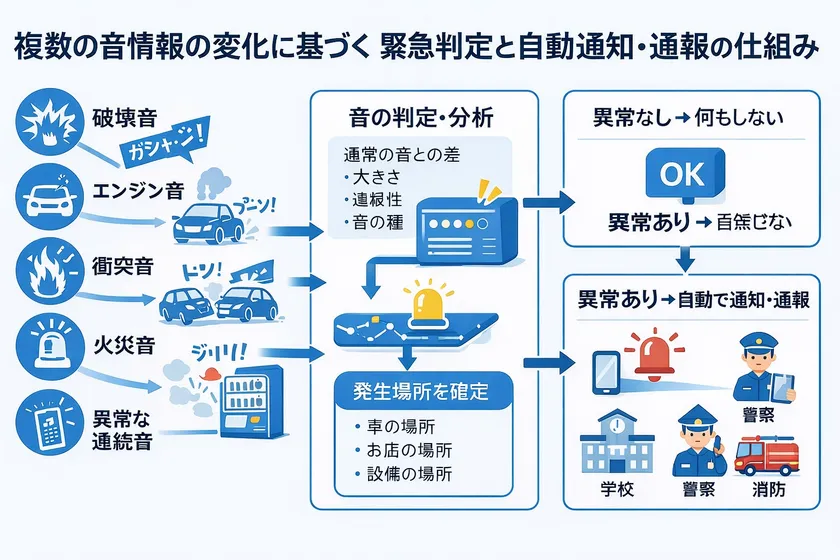
Sound image (1)
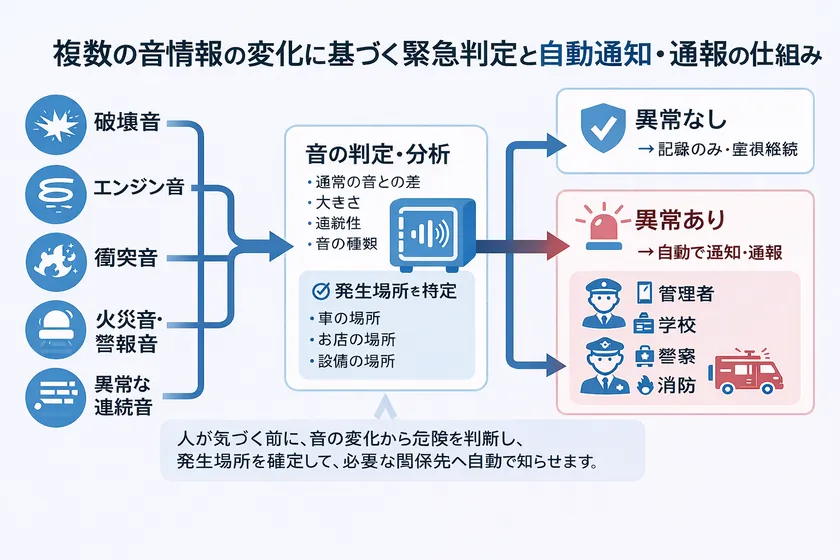
Sound image (2)
Next-generation safety infrastructure that integrates "stop" and "inform" by using "vital" and "sound
Video Commentary: Scope and Contents of the Integrated Patent Right
https://youtu.be/hxV3rdUfklY?si=cpQgTatxBrvnanyo
Video commentary: Vitality analysis (analysis of living and moving bodies)
Security Patent by Detecting Abnormality or Unlocking or Locking Normal Detection by Vitality Analysis (Bioanalysis and Motion Analysis)
https://youtu.be/cS5JBB-AZ74?si=AETwztdk4bXhqFah
Video Commentary: Emergency Alert System and Program Patents for Analysis and Analysis of Sound in General
https://youtu.be/A7Aq6yTJfEU?si=kt0yIGvpCvf-C7nx
Summary of the Announcement (What is being announced?)
Today, Yuki Takeuchi, inventor and patentee, announced two patents that support the next generation of security and safety,
Vital Security Patent (Patent No. 7780682)
Sound General (Emergency Alert) Patent (Patent No. 7796450)
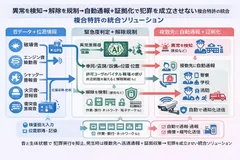
The concept and utilization policy of the "Integrated Safety System as Multiple Integrated Patent Rights" based on the "Vital Security Patent (Patent No. 7780682)" and the "Sound General (Emergency Alert) Patent (Patent No. 7796450)" are announced. This integration is not limited to mere monitoring and notification,
Stop" (release and control the execution) of dangerous operations
Notify" of the danger (automatic notification/reporting)
Leave the evidence behind (evidence storage/encryption).
The system aims to address various on-site issues such as extortion, threats, internal fraud, accidents, disasters, theft, and equipment malfunctions by integrating these three elements.
2. background (conventional issues: why are they necessary)
2-1. Limitations of Conventional Security (Coercion, Inducement, Internal Fraud)
Conventional security has been strengthened by combining PINs, passwords, cards, and biometric authentication such as fingerprints and faces.
In reality, however, situations arise in which the individual is threatened or coerced into operating the system in person. In this case, there is still a risk that the authentication will pass and the safe, car, terminal, important data, payment, etc. will pass as "legitimate operations". 2-2.
2-2 Limitations of Conventional Emergency Calls (Cannot be Pressed, Cannot be Reached, and Leave No Evidence)
In most cases, emergency calls are made by pressing a button or operating an application. However, in the event of an accident, sudden illness, or assault, it is not uncommon for the person in question to be unable to operate the app. In addition, the initial response may be delayed due to failure to receive the call, inadequate explanation of the situation, or lack of evidence, resulting in increased damage. 3.
3. solution (how integration will change this: stop + inform + leave)
This integration clearly separates the roles of the two patents and makes them complement each other.
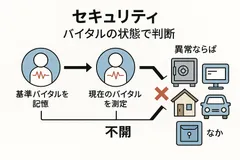
<Vital Security Patent (7780682)
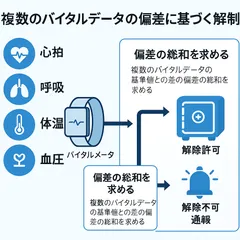
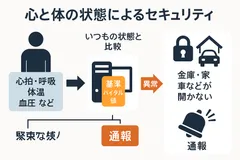
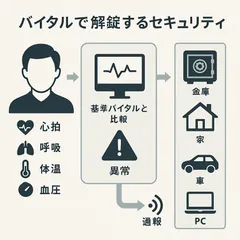
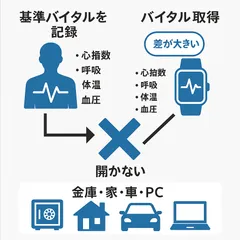
Even if the user is able to operate the device, if the user's vital status is different from usual, the system will stop the release or execution of the device" = Deterrence of unauthorized execution under duress or abnormal conditions.
<Patent (7796450) for all types of sound (emergency alerts)
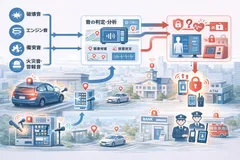
Estimates the situation based on changes in ambient sound and voice, selects a contact, and automatically notifies and reports the situation.
Integrating these two features, for example, "forced to open a safe," "unable to speak due to assault," "fire or destruction in progress," etc., can be used in situations such as "forced to open a safe," "unable to speak due to assault," "fire or destruction in progress," etc.
In such situations, "stop" and "inform" work simultaneously to minimize damage. 4.
4. scope of technology protected by patents (by claim: points of scope of rights)
The following is a summary of the key points for general readers on what is likely to fall within the scope of the right.
4-1. vital security patent (patent no. 7780682)
Claim 1 (core): Judging a dangerous state by adding up (summing up) deviations of multiple vitals and regulating their release and execution.
Claim 2 (enhanced accuracy): Suppresses misjudgment by normalizing deviations, etc.
Claim 3 (extended notification/reporting): External notification/reporting when release/execution is regulated.
Claims 4-5 (vital types, multiple types): heartbeat, respiration, temperature, blood pressure, GSR, etc.
Claims 6-8 (extension of target to be protected): safe, residence, car, terminal, network, electronic data, important process, etc.
Claims 9 to 11 (method): Operational procedure of reference value setting → measurement → deviation calculation → judgment → regulation (+ external notification)
4-2. sound in general (emergency notification) patent (Patent No. 7796450)
Claim 1 (core): Estimation of situation from sound + location → selection of contact person
→ Automatic notification by means of settings
Claim 2 (Where to install): School bags, vehicles, smart keys, wearables, etc,
smart keys, wearables, etc.
Claim 3 (starting condition): Estimation starts by sound pressure, keywords, etc.
Claim 4 (Distance fallback): Emergency estimation based on distance, etc. even in situations where sound cannot be picked up
Claim 5 (non-delivery measures): Reduction of unreachable problems by multi-channel + retransmission
Claim 6-7 (evidence): image capture + encrypted external storage
Claim 8 (Learning model): Improvement of estimation accuracy
Claim 9 (program): software implementation rights 5.
5. comparison with conventional methods (easy-to-understand differences) 5-1.
5-1. Vital side: Stepping into the problem that "authentication = security
Conventional: If the person himself can operate the system, it will be accepted (vulnerable to coercion).
This patent: If the person's vital status is abnormal, the release/execution will be stopped (strong against coercion) 5-2.
Sound side: To eliminate "cannot be pushed", "cannot reach", and "cannot remain".
Conventional: Button assumption/fixed reporting destination/stops when communication fails/not enough evidence
This patent: Situation estimation → contact destination selection → automatic multi-channel reporting → evidence creation → expansion to learning
5-3. difference of integration: "stop" and "inform" are established at the same time
Conventional: Stop (authentication) and inform (notification) are separate, leaving a weak point.
Integration: Stop x Inform x Leave are integrated to reduce omissions in the field. 6.
Assumed cases (who, what can be used, what can be done, and what will happen)
Case 1: Safe opening due to robbery or threat
Who: Store owner, financial institution, facility manager
What: Safe/access device + vital sensor
What: If abnormal, restrict unlocking and notify outside
What happens: Damage is less likely to spread, even under duress, and third-party intervention is quicker.
Case 2: Sudden illness or fall in the home (inoperable)
Who: Elderly persons, family members, care providers
What: Monitoring terminal (microphone + location) + (if integrated) vitals
What: Automatic notification from abnormal sound, sound of falling down, etc.
What happens: Faster initial response even in a situation where it is not possible to push the device.
Case 3: Vehicle theft (vandalism + engine noise)
Who: Individuals, fleets, insurance companies
What: In-vehicle microphone + location + communication
What: Automatic notification based on the estimated results of the destruction sound, continuous impact, and engine start sound
What: Accelerated detection and response, reduced risk of theft
Case 4: Destruction of unmanned stores and vending machines
Who: Store operators, security guards
What: Installed microphone + image capture + encrypted storage
What: Destruction sound → Reporting + Creation of evidence
What happens: Contain the spread of damage, and use for insurance, investigation, and prevention of recurrence
Case 5: Government offices, critical infrastructure (internal fraud/extortion/abnormal conditions)
Who: Government agencies, critical infrastructure, corporate CSIRT/SOC
What: Vital judgment before important terminal/critical operation + regulation in case of abnormality + external notification
What: Stop critical operation in abnormal state
What: Reduce risk of leakage, unauthorized remittance, and critical operation errors
Case 6: Schools and local governments (accident, suspicious person, fire)
Who: Schools, local governments, community watchdogs
What: Microphone + location + notification (to administrator, police, fire department)
What: Early detection of dangerous sounds and automatic notification
What: Initial response is initiated before people become aware of the danger and damage is minimized. 7.
Designing for the Future (Effects on Safety, Security, and the Environment) 7-1.
7-1. safety and security
Reduction of initial response time (automatic notification and contact)
Deterrence of coercion and threats (release control + external notification)
Securing evidence (accountability and deterrence effect by encrypted storage) 7-2.
7-2. security of business and operation (insurance, security, local government cooperation)
Ease of designing linkage and reducing the burden of decision making in the field
7-3. Environmental and Social Effectiveness (Insurance, Security, Municipal Cooperation)
Environmental and social benefits
Early detection of fires and abnormalities in facilities reduces the spread of fire and damage, and contributes to reducing the burden of restoration and waste.
Prevents accidents from becoming more serious, and may lead to reduced emergency transport and medical care load. 8.
8. furthermore (to be "strongest" in combination with Yuki Takeuchi's theory)
In addition to the above patents, Yuki Takeuchi has also invented a theory that has never been used before (the theory of multiple time-varying points with infinite number of keys). This theory is currently in the patent application process, and when combined with this theory, it will become the strongest security enhancement for all security.
9. future development (collaboration and introduction)
This integration is envisioned for a wide range of deployments, including not only dedicated devices, but also incorporation into existing security devices, monitoring devices, smartphones, in-vehicle devices, and facility equipment, as well as cloud integration (management system/SaaS). In the future, we will consider PoC (proof of concept), joint development, and licensing collaboration in various areas such as municipalities, schools, security, insurance, fleet management, and critical facilities.
Comments from the inventor/deviser (Yuki Takeuchi)
I would like to bring smiles to the faces of Japan in the future by improving and solving various social problems through my various projects and inventions.
Mr. Yuki Takeuchi is currently developing the "A-GEL Gift Point & A-GEL Gift Card" service, which allows merchants to give up to 40% back in points free of charge, to support people's lifestyles and business owners through the use of patented rights. A-GEL Gift Point & A-GEL Gift Card services.
Image
Logo Image

- Category:
- Corporate Trends
- Genres:
- Technology General Business Economy(Japan)