
Feasibility Study Results of Data-Driven Farming in Ukraine
Targeting a new region and crops, achieving yield increases within six months through a science-based approach and AI
Greein Inc.

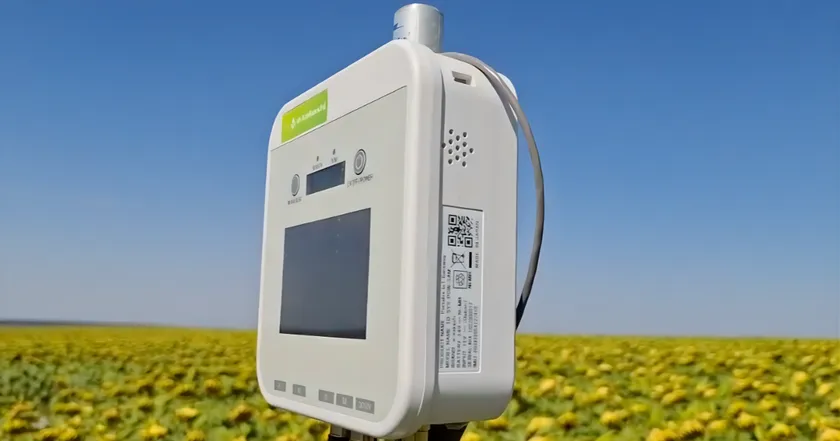
e-kakashi installed in a sunflower field
Greein Inc. (Head Office: Minato-ku, Tokyo; Representative Director CEO Takashi Togami; a leading provider of AI-based smart agriculture solutions; hereinafter “Greein”) has launched a Feasibility Study (FS) on March 3, 2025. The FS is part of the “Green industrial recovery project for Ukraine through technology transfer from and the co-creation of new businesses with Japan's private industries” supported by the United Nations Industrial Development Organization (UNIDO), funded by financial contribution of the Ministry of Economy, Trade and Industry of Japan, and is scheduled to last for 12 months.
This Feasibility Study examines the technological and economic effectiveness of an agribusiness model that integrates innovative technologies such as e-kakashi, satellite image analysis, and high-performance biochar application. This release reports results related to yield improvement.
A total of 16 e-kakashi Gateways were installed across four fields to collect environmental data. Satellite imagery data were used to supplement the environmental data, enabling the AI to monitor field conditions over a wide area and make predictions. Based on these data, AI was developed to predict optimal farming operation timing to maximize yields. The results confirmed a yield increase of up to 9.4% for sunflower and an average yield increase of approximately 13.8% for corn.
<Sunflower: Improving yields by optimizing desiccant application timing with AI>
In addition to environmental data collected in the fields, historical satellite imagery data from approximately 400 fields across Ukraine were used to supplement the environmental data, and an AI algorithm was developed to predict the optimal timing for desiccant application. In field trials in two fields in Lviv Oblast, yields in the experiment field, where desiccant application and harvesting were carried out at timings predicted by the AI to be optimal, were compared with yields in the control field, managed based on farmers’ conventional decision-making. The results confirmed a yield increase of up to 9.4%.
<Corn: Improving yields through AI-based harvest decision-making>
Yields in the experiment field, harvested at the timing predicted by the AI to be optimal, were compared with yields in the control field, harvested based on conventional practice. The results showed that the average yield in the experiment field was 15.17 t/ha, compared to 13.33 t/ha in the control field, a difference of 1.84 t/ha. The results confirmed an average yield increase of approximately 13.8%.
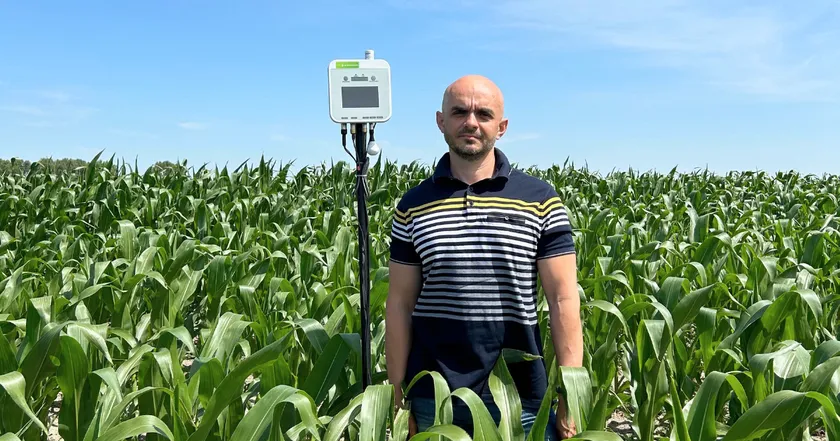
Photo: e-kakashi installed in a corn field, with Associate Professor Patsula of Ivan Franko National University of Lviv
<Toward sustainable agriculture and recovery>
While these results reflect findings from a single year, they suggest that data-driven farming enabled by IoT and AI can contribute to improving productivity in Ukrainian agriculture. Going forward, environmental data will be collected and accumulated across multiple years and multiple regions to further enhance the accuracy of the AI model and expand its application to other crops. Greein will continue to work on building a sustainable industrial foundation that supports agricultural advancement and post-war recovery through advanced digital technologies.
<Related link>
Supporting Agricultural Recovery in Ukraine Feasibility Study Initiated
https://www.greein.jp/en/supporting-agricultural-recovery-in-ukraine-feasibility-study-initiated/
Image
Logo Image

- Category:
- Corporate Trends