
Aplite Electric Appliances Corporation Announces "ESAB," a Rescue Beacon Covering "Blank Space" Connecting Sea and Sky Announces ESAB, a Rescue Beacon that Covers "Blank Space
アプライト電器株式会社

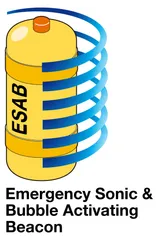
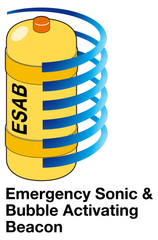
Upright Electric Appliance Co. (Head Office: Tokyo, Japan) has announced the release of its patented (Patent No. 7657396) Emergency Sonic & Bubble Activating Beacon (ESAB), an emergency position reporting device using sound waves and bubbles.
This device is currently at the stage of presenting its basic principle and structure, and specifications for each application and detailed design for commercialization will be studied in the future.
ESAB is a new, power-less, long-acting rescue beacon that is designed to provide location information even from underwater in the event of ship or aircraft accidents or people falling into the water.
ESAB adds a new means to such situations and aims to shorten the time required to find a person.
Background: Areas not reached by conventional rescue methods
The basic concept of ESAB is to "send a signal from the person being searched.
Although radio wave-based maritime rescue devices such as EPIRBs (Emergency Position Indicating Radio Beacons) have saved many lives,
However, they are too difficult for individuals to wear at all times.
They are not designed for underwater use.
They are not designed for underwater use.
In addition, underwater sonar searches are passive, and the wider the search area, the longer it takes to find the device. In fact, in past large-scale accidents, there have been reports of cases in which the discovery of a vessel was difficult over a long period of time (Note 1).
ESAB was conceived to fill the void of "no means of underwater notification" in light of these issues.
Note 1: Cases of long-term difficulty in detection have been reported in the Malaysia Aircraft crash in March 2014, the Air Self-Defense Force F-35A crash in June 2019, and the Self-Defense Force helicopter accident in April 2024.
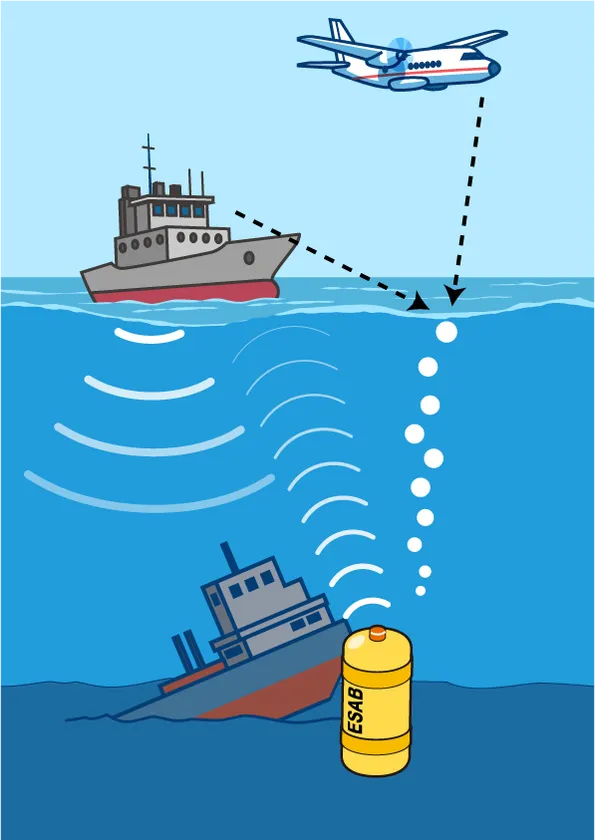
Basic operation image of ESAB (two-layer detection of air and sea (underwater))
■New approach proposed by ESAB
ESAB presents a new rescue call option that can operate for long periods of time and in underwater environments, thanks to its structure that does not depend on an external power source and its dual signal method that combines "bubbles" and "underwater-over-water sound waves". This is envisioned to provide rescue support that continuously links underwater, sea, and airborne searches.
Key Points of the Technology (Introduction and Summary)
Outline
A rescue beacon concept with a dual signal mechanism combining "bubble generation" and "underwater sound waves" in the body of a pressure-balanced structure. It does not require a power supply and is oriented toward long-term operation.
The gas is supposed to be generated from a solid, to achieve both safety and long-term operation.
Reach range (condition-dependent)
Underwater sound waves are expected to reach approximately 1 to 3 km, or several kilometers when conditions are favorable. Supplement search in difficult-to-see conditions such as nighttime and stormy weather.
Tentative specifications (under consideration)
Adopts a pressure-balanced structure that can be used from shallow to deep water. The gas generation system for deep sea is still a future issue, but certain prospects have been obtained.
Assumption of human-use model
A model for human use is assumed for coastal and shallow water applications. It is expected to be commercialized relatively soon for the purpose of immediate notification and subsequent search support for maritime workers and marine recreation enthusiasts who fall into the water.
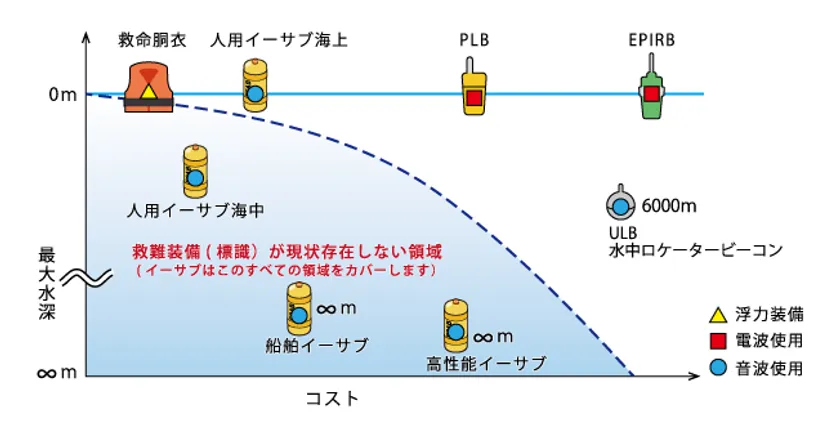
ESAB to cover the blank area of underwater search
■Future Information Disclosure
This presentation is an introduction to the ESAB series, showing its basic concept and technical positioning.
It is envisioned to be deployed for multiple applications through modularized structure, such as personal equipment, ships, aircraft, defense, marine development, and industrial applications.
Information on the following themes is scheduled to be released sequentially.
Aerospace and defense applications
Concept of a compact, personalized model
Technology study for deep sea application
Industrial applications such as undersea markers
Patent publication and international deployment
Expected market size (for reference)
ESAB is a rescue notification device that is expected to be used in multiple fields, from defense and industry to personal equipment. According to estimates based on publicly available information and the deployment status of existing equipment, there are several fields where a certain scale of introduction is possible.
The main purpose of this report is to show the positioning of the technology and the direction of its utilization. The details of the specific market size and demand forecast will be supplemented in the final article of the series (article 8).
To those interested in this concept
We welcome inquiries from companies and organizations interested in this concept regarding joint development, product commercialization, mass production design, OEM deployment, and commercialization.
Company Profile
Applied Electric Appliances Co.
Location : Tokyo, Japan
Business description: Planning and development of electrical and electronic equipment, etc.
URL : https://aplight.biz/esab
Technical Notes
This device is currently in the basic principle and structural design stage, and detailed designs for application-specific specifications and product commercialization will be studied in the future.
The performance, reach, depth of application, and operating period described in this release depend on design conditions, sea conditions, and environment.
ESAB is not intended to replace existing EPIRB/SART (radar transponder for search and rescue) but is proposed as a complementary device to them.
Patent Information: Japan Patent No. 7657396 / U.S. Patent Pending
■Contact for inquiries
Applied Electric Appliance Co.
Attn: HAYASHI
tel : 03-6410-7752
Cell Phone: 090-8580-4990
Email: press@aplight.biz / esab.beacon@gmail.com
Image
Logo Image
- Category:
- Corporate Trends
- Genres:
- Technology Economy(Japan) General Business